Agentic AI in Healthcare: What Every PM Needs to Know
Mar 15, 2026
|
If your roadmap doesn't account for agentic AI, it's already behind. We're not talking about AI that answers questions — we're talking about AI that acts: scheduling follow-ups, flagging deteriorating patients, filling prior authorizations, and coordinating care autonomously. |
|||
In this issue |
|||
|
This edition covers the key ideas from my latest video — what agentic AI actually means for healthcare product managers, a prioritization framework you can use today, and the use cases already driving measurable ROI. Plus: the #1 mistake most PMs make when building in this space. |
|||
What is agentic AI? |
|||
|
Traditional healthcare AI is reactive…a clinician opens a chart, and the AI shows a risk score. The human stays in the driver's seat. Agentic AI is different: it perceives its environment, sets a goal, takes sequential actions, and self-corrects with minimal human intervention. |
|||
|
A standard AI copilot suggests the prior auth. An agentic AI submits it, monitors the payer response, escalates if denied, and routes the appeal while your staff is helping patients. |
|||
|
|||
|
The PM challenge |
|||
Why healthcare AI is different |
|||
|
Building agentic features in healthcare isn't just a software challenge… it's regulatory, clinical, and organizational all at once. Three forces shape every roadmap decision: |
|||
|
Regulatory constraints |
|||
|
FDA clearance, HIPAA, and emerging frameworks like ONC's HTI-1 rule on algorithmic transparency mean compliance must be a design partner, not a sign-off step at the end. |
|||
|
The trust gap |
|||
|
Clinicians have seen too many AI tools that promise everything and deliver alert fatigue. Agentic features must earn trust through transparency — showing why the agent acted, with a frictionless human override, every time. |
|||
|
Workflow integration vs. disruption |
|||
|
The best agentic AI fits into existing workflows. If your agent requires staff to go to a new portal, adoption stalls. Surface it in the EHR, in the inbox, wherever your users already live. |
|||
|
Framework |
|||
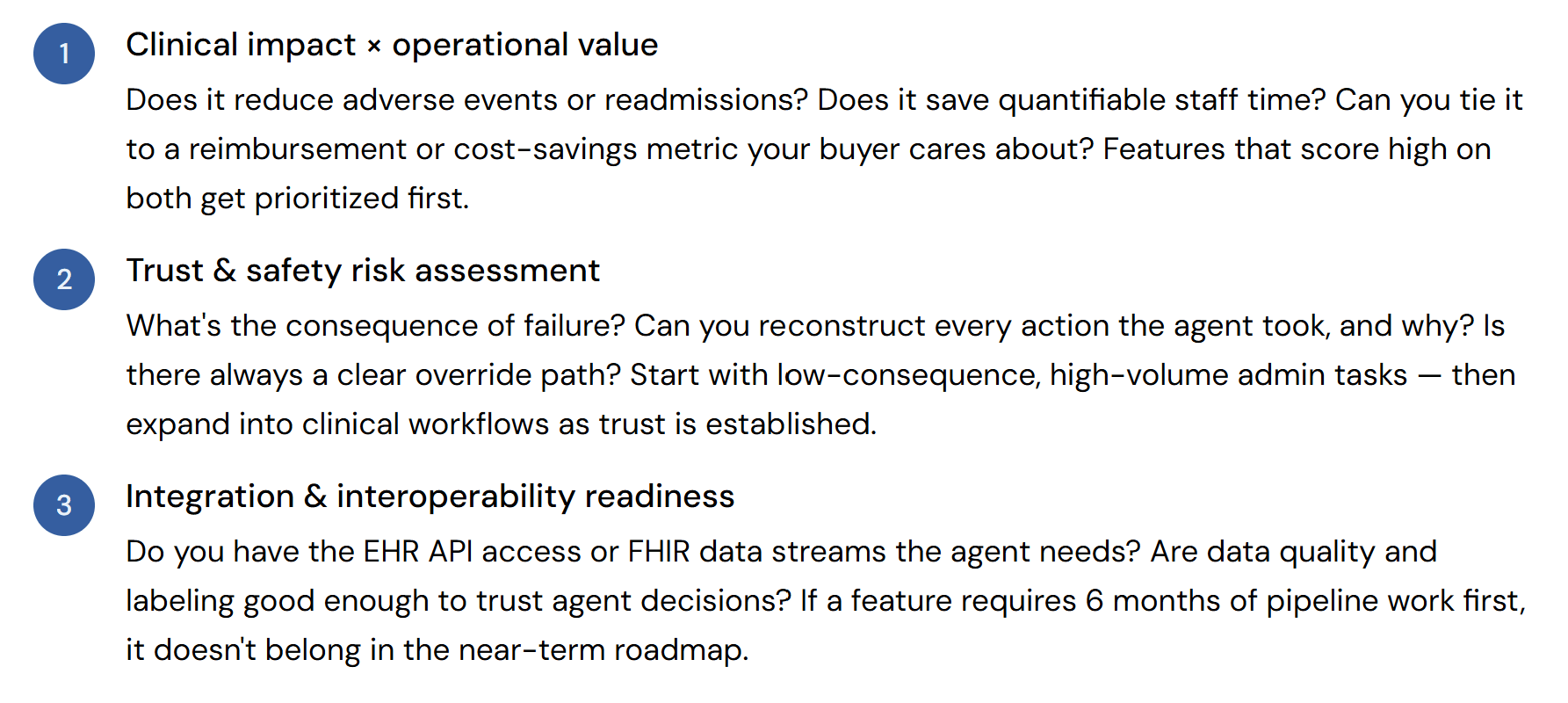
The 3-layer prioritization framework |
|||
|
Use this to evaluate every feature before it goes on your roadmap. |
|||
|
|||
|
Where to focus now |
|||
Top 3 use cases driving ROI in 2025 |
|||
|
Revenue cycle |
|||
|
Prior auth & denial management automation |
|||
|
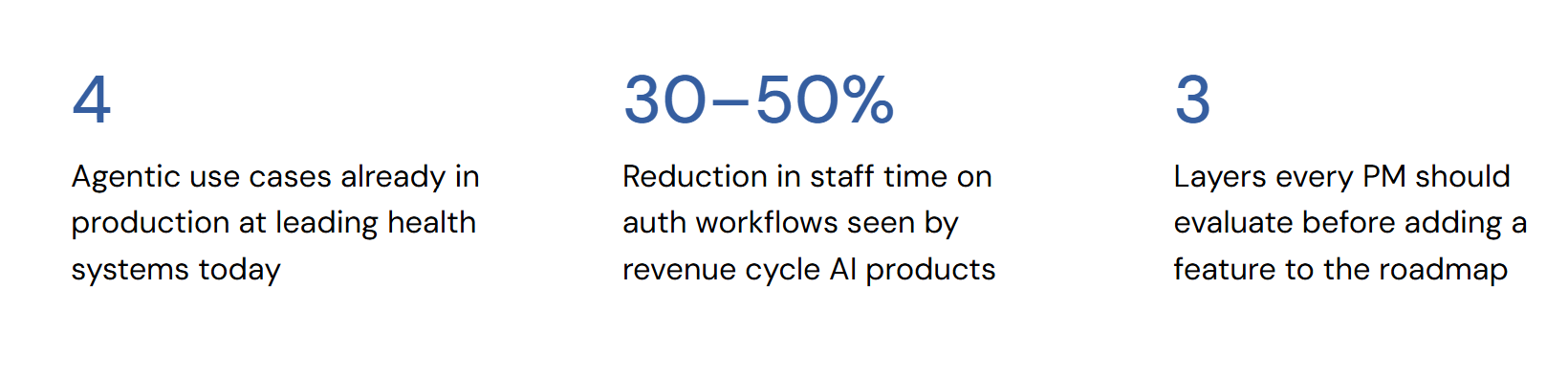
High-volume, rules-based, painful — exactly where agentic AI excels. Products in this space are seeing 30–50% reductions in staff time on auth workflows and measurable drops in denial rates. |
|||
|
Clinical documentation |
|||
|
Ambient documentation + autonomous coding |
|||
|
Beyond transcription: AI that listens to a patient encounter, generates a structured SOAP note, suggests ICD-10 and CPT codes, and routes it for physician review — all before the doctor leaves the room. |
|||
|
Population health |
|||
|
Care gap closure outreach agents |
|||
|
Agents that autonomously identify care gaps, personalize outreach by communication preference, and schedule the right appointment with the right provider — delivering measurable improvements in preventive care and quality scores tied to value-based contracts. |
|||
|
The #1 mistake |
|||
|
Most PMs build the AI feature before solving the human workflow. You can have the most accurate agentic model in the world — but if the nurse doesn't know why it flagged a patient, if the biller doesn't understand why it sent that auth, you don't have a product. You have a liability. Build the explainability UI first. Build the audit log. Build the override. That's what earns adoption in healthcare. |
|||
Want the full breakdown including the complete 3-layer framework and a deeper dive into each use case? |
|||
Watch the video on YouTube. |
|||
|
|||
|
Three things to ALWAYS remember: |
|||
|
Be CONFIDENT! |
|||
|
Be EMPATHETIC! |
|||
|
AND ALWAYS HAVE PASSION!!!! |
|||
|



Check out our FREE eBook, Discipline Made Simple: 5 Proven Steps to Transform Your Life in the next 30 Days
Stay connected with news and updates! Join our mailing list to receive the latest news and updates from our team. Don't worry, your information will not be shared. We hate SPAM. We will never sell your information, for any reason.
